
Right-to-Win Research: The Tradeoffs Behind Real Advantage
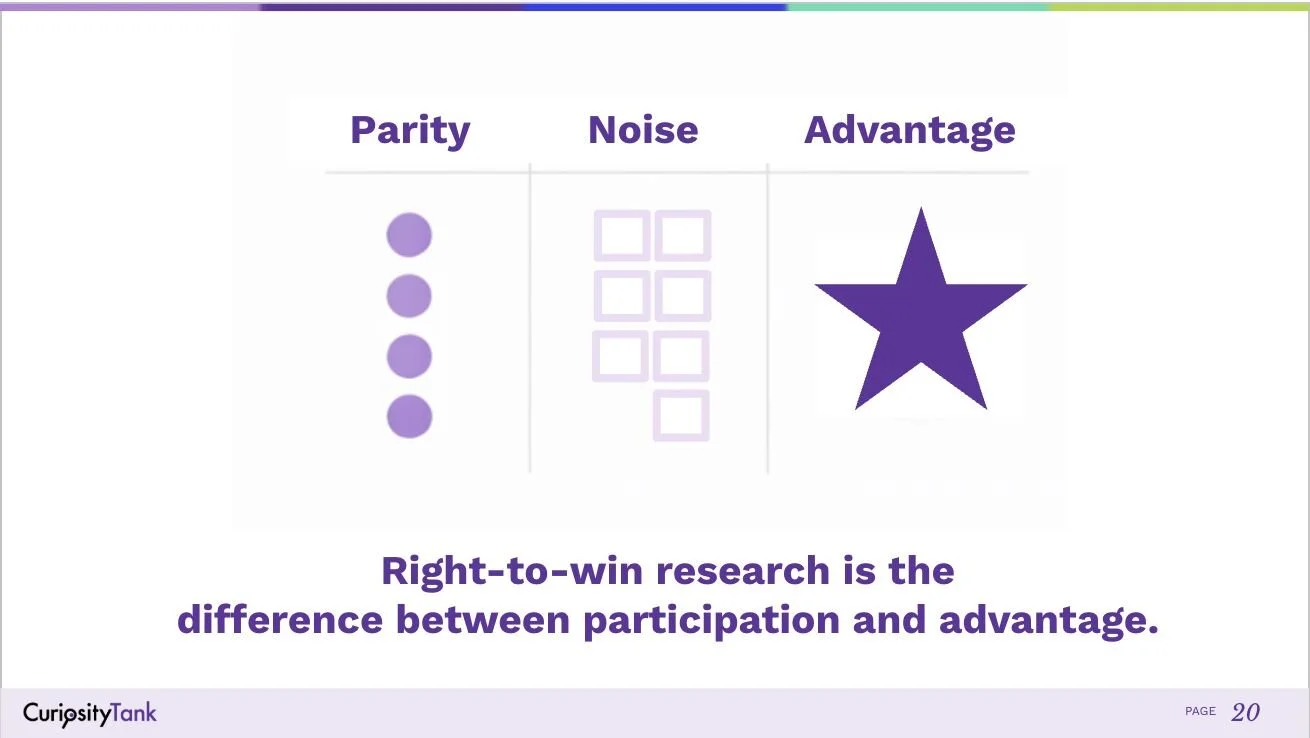
Right-to-Win research is strategy work. In practice, it’s uncomfortable. Because it forces explicit tradeoffs. In generative work, you expand options. You surface needs. You identify opportunity spaces.
In Right-to-Win work, you narrow.
You cannot win everywhere.
You cannot invest everywhere.
You cannot differentiate on every dimension.
So you have to choose.
In a recent R2W logistics study, the market was fragmented but not unsophisticated. Operators had real alternatives. Switching was costly. Contracts were long. And sticky. Relationships mattered.
Internally, there were multiple directions the team could pursue. All defensible. All interesting.
But when we mapped actual contract award criteria against the competitive set, something became clear.
Some capabilities were parity. Required for consideration, unlikely to drive selection. Some operational pain points were loud in interviews, but rarely decisive in final vendor choice.
And one factor consistently determined who won and who lost. Not because it was flashy. Because it reduced risk in high-volume, high-visibility deployments.
That clarity changed the conversation.
It moved the team from: “Should we compete here?” to “What are we willing to build advantage around?”
Right-to-Win research makes those distinctions explicit.
Strategy is not adding more. It is choosing if and where to compete.
That is the difference between participation and ADVANTAGE.
