UX Research: The Difference Between Findings and Insights
The words 'finding' and 'insight' have been used interchangeably for years. We need to stop. I can tell immediately how savvy you are or a platform is by how you use these terms. And I say that not to judge, but because this distinction matters more right now than it ever has, and the industry needs to get it right.
They are not the same thing. Not even close.
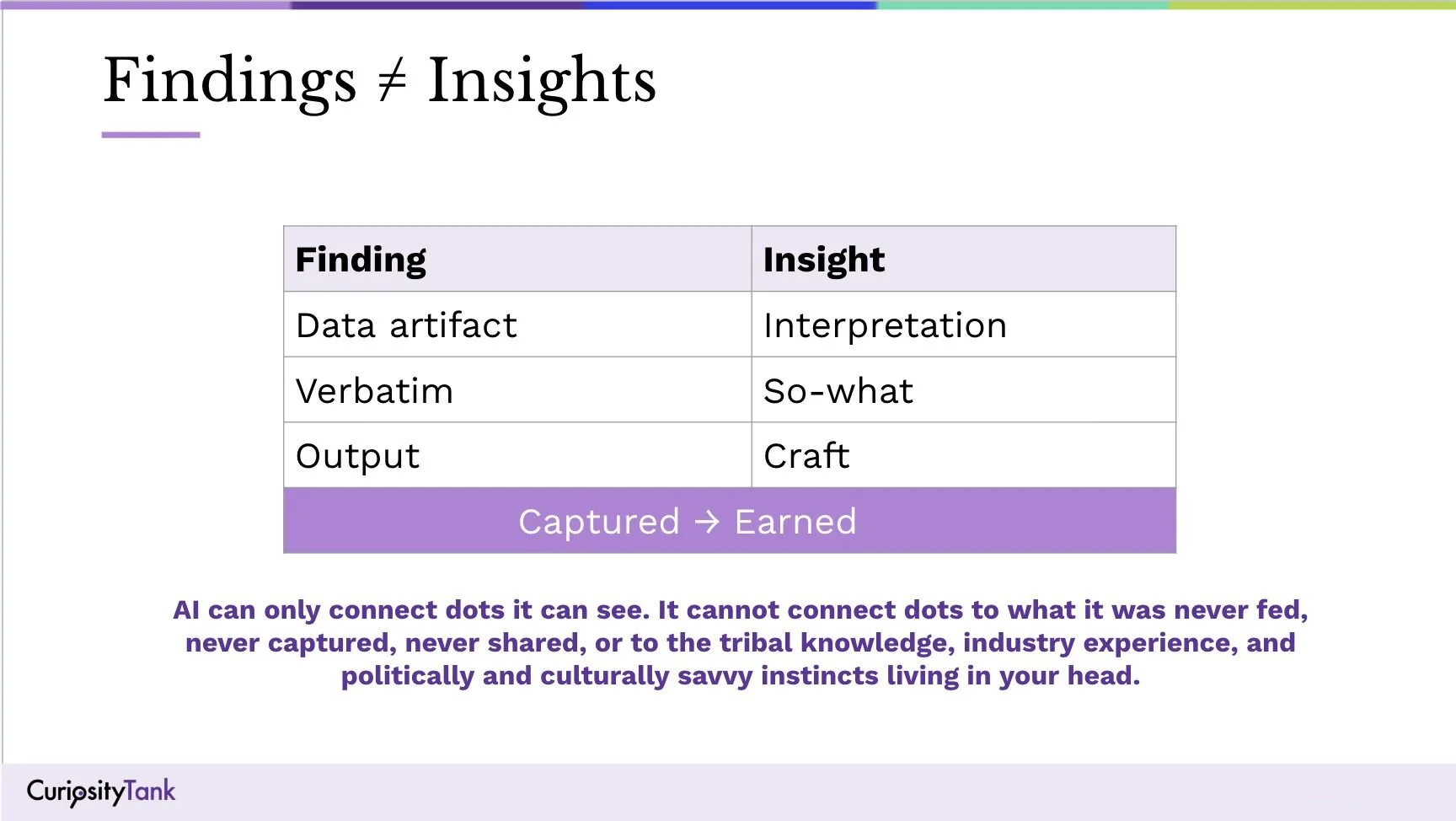
A finding is a data artifact. A verbatim. An output. Something a participant said, something observed, something captured, drawn from what was created, seen, and/or heard. Findings are real. They exist whether or not anyone does anything with them.
Like a symptom, such as sneezing.
An insight is what a human does with one or more findings (like multiple sneezes). The interpretation. The so-what. The connection to something that actually matters to the business, the user, or the decision at hand.
Like the allergy diagnosis that changes how you treat the patient.
Findings are captured. Insights are earned.
And here's the part that doesn't get said enough: insights are not a guaranteed outcome of every research study. The leap from finding to insight typically requires thorough, thoughtful interpretation. It's usually not obvious. It typically requires tribal knowledge, industry experience, and the kind of pattern recognition that comes from doing this work over time. It can happen alone. It doesn't happen automatically.
Here's why this distinction matters more now than it ever has.
AI can be exceptionally good at collecting and organizing findings. That part is genuinely useful.
But if I see one more AI platform claiming to surface insights in minutes, I'll scream.
They don't. They can't. Because insights require judgment, the ability to look at what the data says and know which part of it actually matters, and why. They require taste, the instinct to recognize when something is conspicuously absent, when a participant almost said something important and stopped, when the pattern that only appears twice is the ONE that changes everything.
AI can only connect dots it can see. It cannot connect dots to what it was never fed, never captured, never shared, or to the tribal knowledge, industry experience, and politically and culturally savvy instincts living in your beautiful mind.
So the next time someone hands you an AI-generated "insights report" ask yourself: are these actually insights? Or are they well-organized findings dressed up as 'themes' in insight clothing?
Because one of them moves decisions. The other one fills decks.
Findings are the raw material. Insights are the craft. Don't confuse the two.
