Now what? Vibe Coding Got Me This Far
Last week, I faced a harsh reality that many AI-enabled builders are about to face.
Vibe coding can be excellent for creating an MVP and beta testing an idea. It can get you shockingly far, shockingly fast.
But the distance between a working MVP and a sellable, scalable product is enormous.
Many founders start with an idea, then struggle to find the use cases, pain points, and urgency required to create real pull — what the industry calls product-market fit.
My path was different.
I did not set out to build a SaaS product. I set out to create a teaching example that solved a problem I could not unsee.
Most research platforms start in the middle or at the end of the research journey.
They either help you collect the data or help you analyze and synthesize what you already collected.
But that assumes everything upstream was sound to begin with: the planning, the screening, the guide, the sample, the questions, and even whether the study was important enough to run in the first place.
In other words, they assume you asked the right people the right questions in the right way — and that the study was right-sized to move the needle on business goals.
So I went down a rabbit hole and wound up developing an MVP for that problem — one people appear willing to buy and use.
That is exciting! It is also clarifying!
The MVP works. And the beta testing results are extremely positive. But a real product needs authentication, data storage, security, compliance decisions, billing, onboarding, customer support, uptime, QA, error handling, and a maintenance plan.
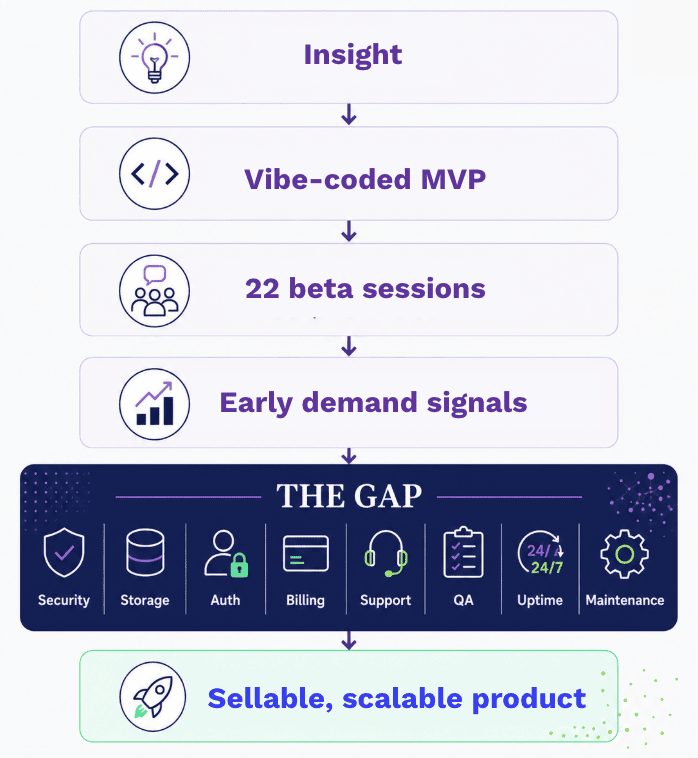
That's the reality I am sitting with now.
So I am working with product engineers to assess what it would take to get it over the line: the time, the funding, the technical requirements, and the operating model.
I am also asking a harder question: do I actually want to build and run a SaaS company?
There is no doubt that this next phase would stretch me and my current skills to the max. But the bigger question is not whether I can learn it.
It is whether I want the business that comes with the product.
It is one thing to be a research builder. It is another thing to become the founder of a SaaS company and run it.
My pros and cons lists are ongoing.
The silver lining is that vibe coding can get you very, very far. It can turn an abstract recommendation into something people can see, use, and react to. It can reduce the layers of misinterpretation and production effort that often sit between insight, action, and implementation. And it can help you prove a concept, test willingness to buy, and surface early product-market fit signals.
The #truthbomb is that proving people want something is not the same as being ready to sell, secure, support, and scale it.
AI can help you build faster than ever.
But it cannot answer the harder question: once people want what you made, are you willing to become the founder it requires?
One more thing — May 20th
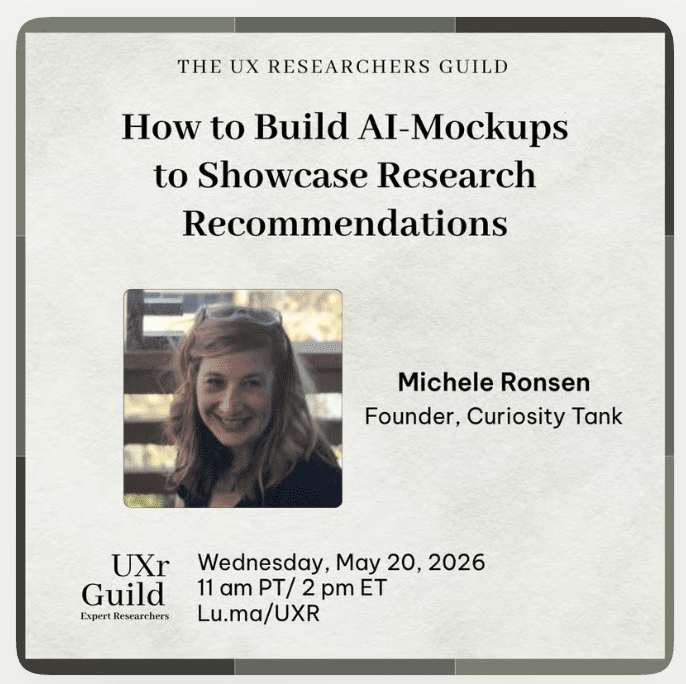
The UX Researcher’s Guild presents How to Build AI-Mockups to Showcase Research Recommendations with Michele Ronsen, Founder of Curiosity Tank
I'll be presenting at a UXR Guild event on May 20th: "How to Build AI Mockups to Showcase Research Recommendations." And yes — I'll be sharing Plan Like A Pro: Together live. It's the recommendation, taken to the nth degree. I couldn't help myself! And a preview of BUILD Like A Pro, Course 7 in the Ask Like A Pro series.
Come see it in action, ask hard questions, and get inspired to become a researcher who builds!
Speak up, get involved, and share the love!
Connect with Michele on LinkedIn for more UXR tips and UX discussions.
Read about Curiosity Tank workshops.
Interested in team user research training? Let us know!
Participate as an On-Demand for less!
Dive into a different UX Research term every week! Sign up for UX Lex weekly emails here.
Forward this email to someone you think might enjoy it. Better yet, sign them up here. It will be the gift that keeps on giving.
And that’s a wrap!
We try to alternate between a theme and Insights/UX/UXR jobs, events, classes, articles, and other happenings every so often. Thank you for all of the feedback. Feedback is a gift, and we continue to receive very actionable input on how to make Fuel Your Curiosity more meaningful to you.
What do you think? We're constantly iterating and would love to hear your input.
Stay curious,
- Michele and the Curiosity Tank team
