
Show Your AI Competency, Don’t Just Describe It
Two institutions. Nothing in common. Same conclusion.
Nielsen Norman Group, June 2026. Paz Perez argues the emerging design discipline for AI systems is context architecture: organizing information so machines can interpret it, structuring what a system should remember, deciding what it should never do. Structure, meaning, mental-model articulation. She calls it the natural next chapter for information architects.
The European Commission’s EPALE platform, its adult learning arm, is making a parallel argument for the rest of us. Prompt literacy, they say, is emerging as a foundational adult competence alongside digital literacy and the traditional skills of reading and writing. Their examples span customer service, writing, data analysis, teaching. Not one industry. All of them.
Two sources. Two audiences. One skill.
The ability to describe intent, structure context, and articulate what good looks like is becoming the baseline skill of working life. This is why I'm so bullish about Build Like A Pro.
What neither article says: researchers already do this professionally.
Years ago I conceived of and led the UX Lexicon, a shared glossary of UX and research terms with agreed definitions. Dozens of people around the world contributed. I watched too many projects go sideways when people weren’t aligned. One person’s insight was another’s finding was another’s observation. A shared vocabulary isn’t semantics. It’s a precondition for success.
Researchers are context architects. They just don't call it that.
Controlled vocabulary. Shared definitions. Mental models made explicit.
Every research plan is a spec for what a study should accomplish.
Every discussion guide is a controlled vocabulary.
Every synthesis is an exercise in structure and hierarchy.
Every stakeholder alignment conversation is mental-model articulation. You’ve been doing context architecture your whole career.
You just called it research.
Have you translated that skill into something visual?
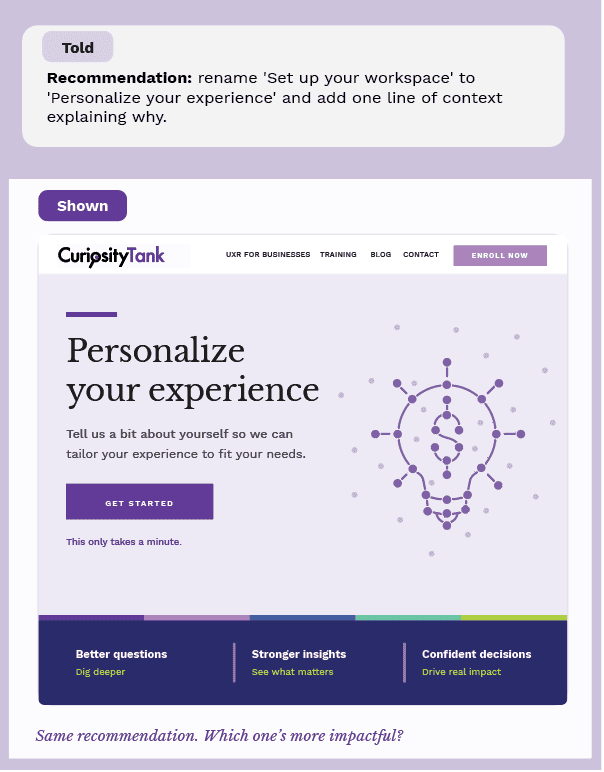
The shown version: ten minutes.
One BUILD learner had been using Claude almost entirely for text. Transcripts, workflows, documents. They knew visual artifacts existed but had barely touched them. What changed wasn't their skill. It was their sense of what was possible to make, how quickly it could come together, and the desire to go much further.
That’s what BUILD Like A Pro teaches.
Not coding. Not design. The translation. The foundation. You bring the skill you already have: describing a problem, defining an audience, articulating what success looks like. BUILD teaches you to use it to produce a working visual artifact in three hours. Real enough to test. And share. Real enough to add to your portfolio, or build on from there.
Recommendations aren’t enough anymore. Making is. Showing is. Shipping is.
The good news is that you’re closer than you think. Looking for a new role right now? Getting asked about your AI competency in interviews? Show them. Don’t tell them. One seat per cohort is reserved at 50% off for anyone between roles.
Next BUILD cohorts:
Tuesday, July 21 · 3–6pm PT / 6–9pm ET, 2 seats remaining
Wednesday, July 29 · 9am–12pm PT
Tuesday, August 4 · 3–6pm PT
$197 · Live online · Max 8 students · No prerequisites

P.S. I’m not a developer, yet I built an AI research planning partner and asked 25 practicing researchers to kick the tires and try to break it with me. What they found taught me more than anything that worked. This Wednesday at 9:10am PT / 12:10pm ET, I’m sharing the whole story. The wins, the hard lessons, and where it stands today. Doing my part to stop the slop.
Join me for “Don’t Scale the Slop” at QRCA Qual Tech Days 2026, Day 2: New Practices. No hype. Just what’s working, what isn’t, and what deserves a closer look. The full event runs three days, July 21–23. Non-QRCA members are welcome. QRCA details and registration here.
Speak up, get involved, and share the love!
Connect with Michele on LinkedIn for more UXR tips and UX discussions.
Read about Curiosity Tank workshops.
Interested in team user research training? Let us know!
Participate On-Demand for less!
Dive into a different UX Research term every week! Sign up for UX Lex weekly emails here.
Forward this email to someone you think might enjoy it. Better yet, sign them up here. It will be the gift that keeps on giving.
