INTRODUCING
Stop telling. Start showing.
ASK LIKE A PRO - COURSE 7
Live Online · One session · 3 hours · Limited to 8 students · No Prerequisites

You did the research. Earned the insight. Delivered the recommendation.
It was misinterpreted. Deprioritized. Shelved. Anyone who has ever watched a great recommendation disappear knows this pain. This course is the fix.
What if you could show them instead?
What used to be enough isn’t anymore.
Sharing literal recommendations isn’t enough anymore. Making is. Showing is. Shipping is. Any researcher who wants to stay relevant has to learn these skills.
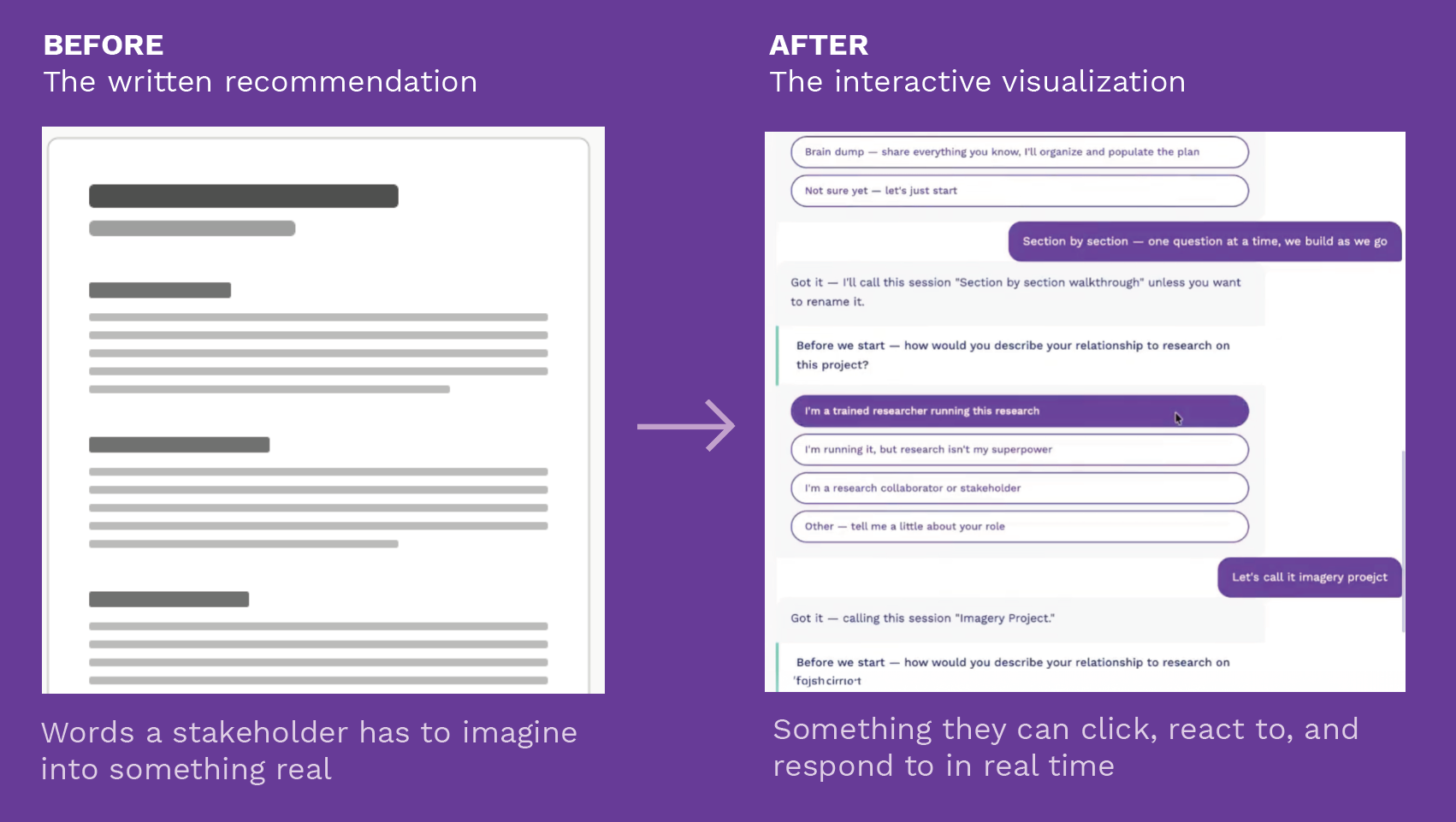
Businesses don’t have time for decks and reports. They need to see it, touch it, react to it. Fast, affordable, good enough — that’s what teams want now. Researchers who can deliver tangible visuals are indispensable. Researchers who can’t are at risk.
Researchers don’t build because they want to be builders. They build to bring their insights and recommendations to life. To remove the barriers between recommendation and action. To get ahead of the misinterpretation, the resourcing debates, the prioritization battles, and the handoff issues that swallow good work whole.
“But I’m not a designer.”
Neither is the point. You don’t need to learn to code or design. You need to learn to turn your recommendations into a prompt to inform the design. That’s an easy bridge to build.
This isn’t about design talent. It’s about translating your recommendations into tangible visualizations. You’ve watched real people interact and respond. You know what confusion looks like, what friction feels like, and how better could manifest. That’s enough to work with.
We'll show you how to find the right visual references — and use them to prompt your way to something real.
This will be a safe space. Judgment-free, structured, and designed for doing. You will leave with something real. Not polished. Real. Because the real value isn’t the artifact — it’s what happens in the room when someone experiences it. It’s the moment someone says — I get this. We need to explore this. We cannot ignore this.
-
You don't need to code.
You need to learn how to prompt for visuals — to describe what you want clearly enough for the tools to produce it. Researchers articulate what good looks like for a living. Visual prompting is just the next sentence.
-
Getting to 80% is the goal.
Not a polished product. Not a final design. The bones. Real enough to put in front of people — to answer a question, illustrate a recommendation, or test an idea. Stop when you can do that.
-
Agency from day one.
Researchers who build don’t wait for someone else to act on their work. They don’t wait for the prioritization meeting, the design queue, or the next sprint. They show what they mean — and the conversation starts there.
Are we building the right thing? Are we building the thing right?
Both are research questions. Both are yours to answer.
Most teams skip straight to the second question — are we building it right? They build fast, iterate fast, and hope the direction is right. It often isn’t. And when it isn’t — the researcher usually knew.
The problem isn’t the answer. The problem is that a written recommendation isn’t enough to make the answer land.
The question used to be: what can we build? We figured out pretty quickly that we can build almost anything. The question has shifted to what should we build — and how do we know we built it right? That’s your territory. Always has been.
Become the catalyst. Build the prototype that makes your recommendation impossible to ignore. Reduce the risk that your best work gets shelved, misinterpreted, or quietly deprioritized before it ever reaches the people it was meant to help.
Who It’s For
Complete beginners welcome. If you’ve already been experimenting, this takes you further.
✔ Anyone who has ever watched a great recommendation disappear
✔ Researchers and research operations professionals
✔ Independent consultants who want to deliver more than a report
✔ Marketers and non-designers who want more agency and impact
✔ Anyone between roles who wants a portfolio piece and a new skill