Someone Folded a Bear on Our Bed
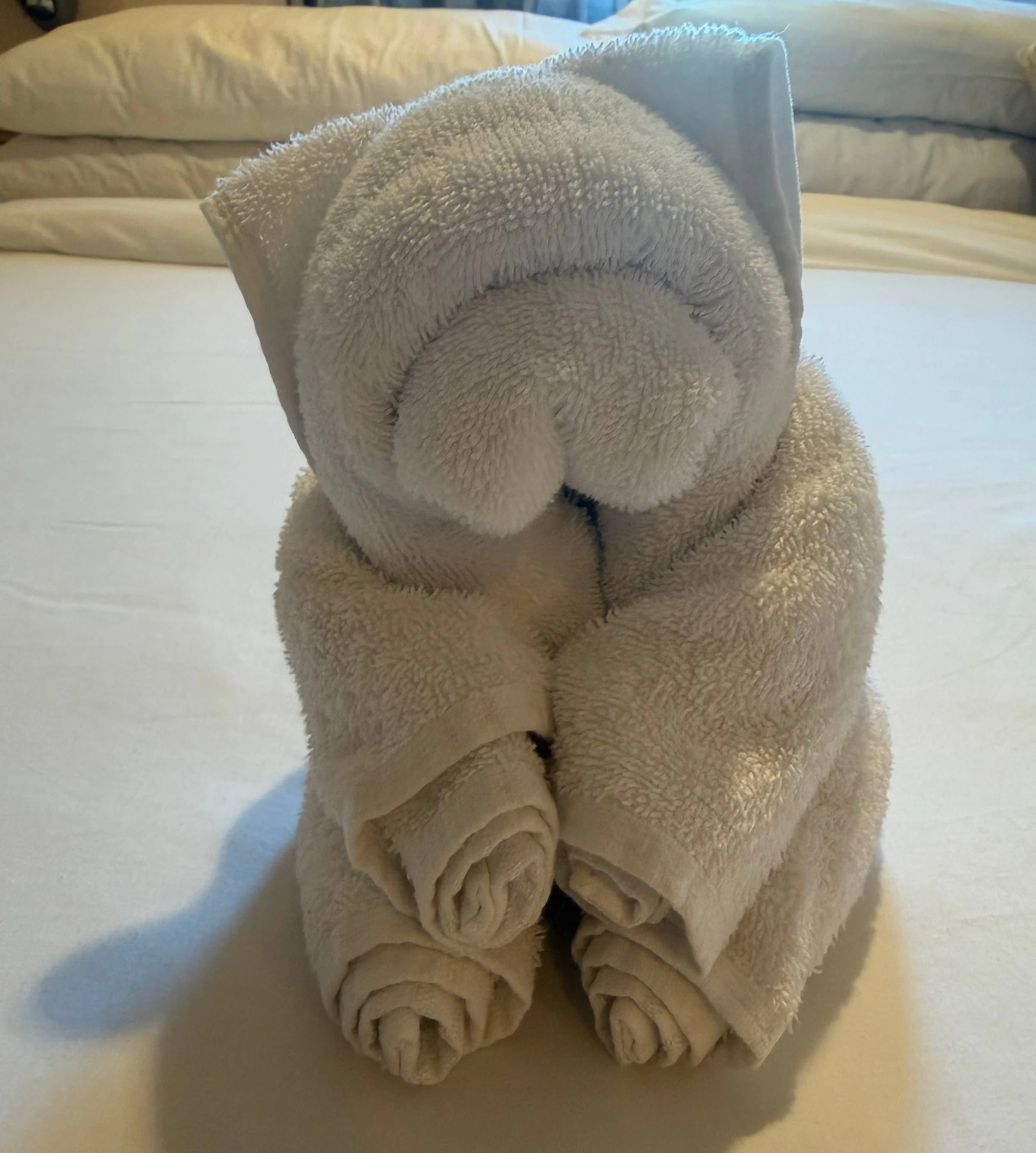
The bear was waiting on the bed.
My daughter and I had been traveling all day. So hot. Drop your bag and Ro Sham Bo for the bathroom, tired. And this small bear is made of towels.
We smiled at the bear and each other. I took a picture. Then I looked at it for a few more seconds.
And later went down a rabbit hole.
A quick history lesson.
Turns out towel animals evolved from origami. They are most often associated with Carnival Cruises, which made its towel-animal debut in 1991. Carnival's ship attendants now receive over 10 hours of training in towel animal creation. There's a published book with 40 different configurations. The practice has been adopted by hotels and resorts globally. There's a small body of literature on the lost art of towel origami.
Who knew?!
This is craft. Trained, practiced, repeated craft.
Someone teaches it. Someone learns it. Someone repeats it, hundreds or thousands of times, in rooms they will never see the inside of again, for guests they likely won't meet.
The bear was extra.
The person who folded our bear was not paid to make us smile. They earn their wages by cleaning rooms.
The first towel animal I remember seeing was in Cuba around 2003. It was a swan.
Do you think they have towel-animal KPI trackers? Towel animal stakeholder reviews? Towel animal NPS scores to measure guest delight? And these are all tied to a quarterly business review?
The bear is uncompensated craft.
Or is it?
Someone, everyone(?), keeps making them. Hundreds of thousands of them. Every night. All over the world.
I've read welcome cards in hotels.
They are somewhat warm. Usually well-written. Always wish you a memorable stay. And my name, Michele Ronsen, is always misspelled as Michelle Ronson. Argh. They are 1000% unmemorable.
I do remember the towel bears, frogs, monkeys, lizards, and swans, though.
Why? Because the cards told me how to feel.
The towel animals made me feel it.
A towel animal makes everyone smile, doesn't it?
This is the same black hole that swallows great research recommendations.
The report tells the stakeholder how to feel about your recommendation. The prototype makes them feel it.
You can write a forty-page slide deck or topline arguing that something is broken or that something is possible. Cite the quotes. Include the annotated diagrams. Present it twice. Follow up four times.
Or you can build a thirty-second clickable mockup that shows them what it feels like. Click. Click. Click.
Broken or brilliant. They feel it. They turn to the engineer next to them and say we have to fix this. Or we have to build this.
The artifact did what the report could not.
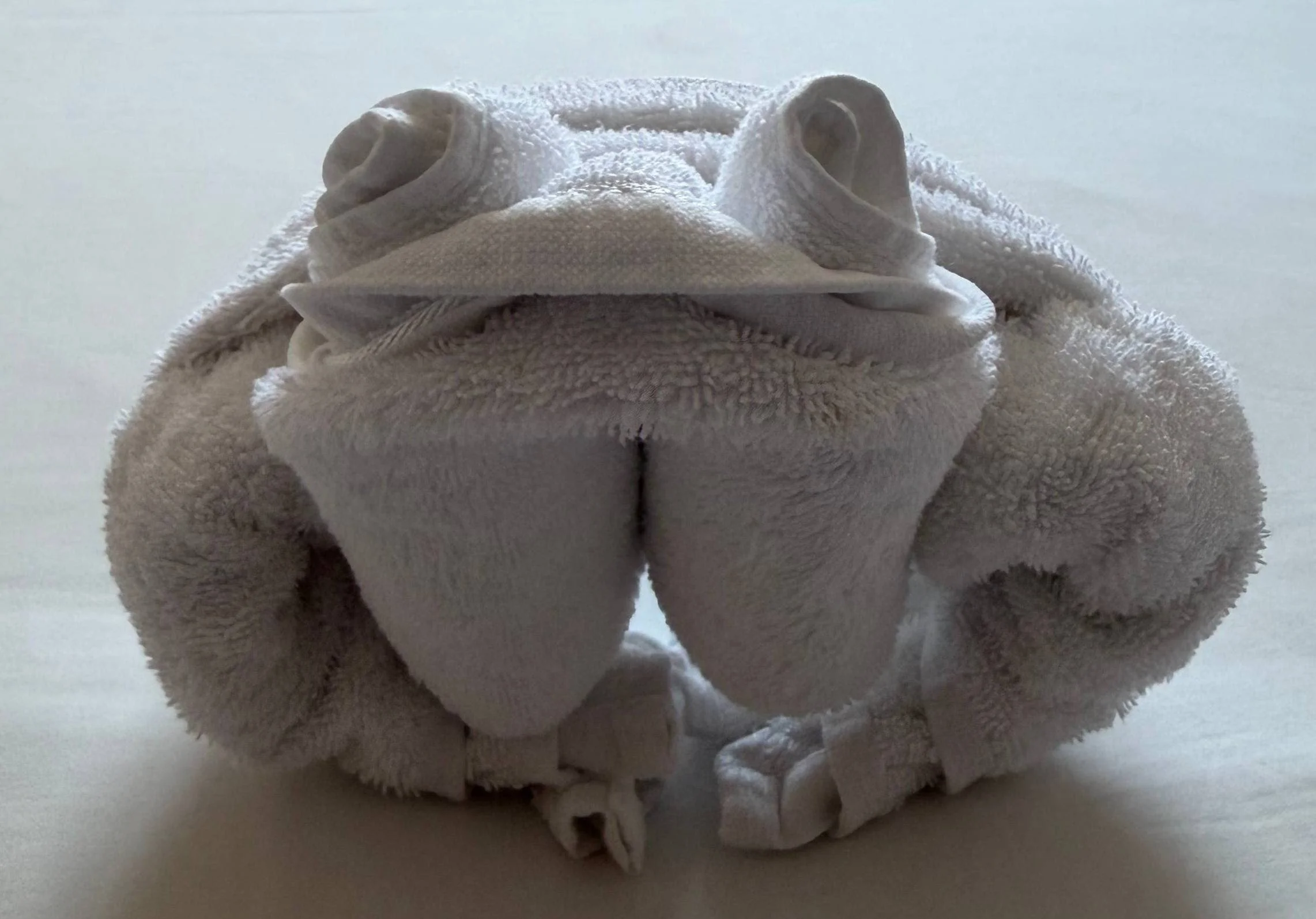
The bear was not alone.
There was a frog the next day. The folds, the eyes, the slightly hunched posture, all different, but the same hand. The same craft. The same person quietly does the part of the job that not everyone is expecting. Yet. Are they silently expecting? Or would they be surprised, even delighted?
Two towel animals. Two nights in a row. One person, anonymous to me, who decided what the room felt like was the job.
That pattern is what makes a hotel memorable to me. One of many things. A big one.
It is also what makes a researcher indispensable.
Small acts of building compound.
One scrappy prototype does not make you indispensable. Doing it once a quarter, when the stakes are highest, can be enough. Doing it more often is what changes the relationship. Adding it to your resume skills arsenal is a standout.
The stakeholder stops asking when will the written report be ready?They start askingcan you show me what you mean?
You stop being the person who delivers the recommendation. You start being the person who makes the recommendation impossible to ignore.
You already know how to do the work.
You know what confusion looks like and what friction feels like. You know what better could look like, because you have watched real people interact with real things and react in real time.
You do not need to be a designer or learn to code. You need to learn how to prompt for a visual. To describe what you want clearly enough that the tool can build it. Researchers articulate what good looks like for a living. The prompt is the next sentence.
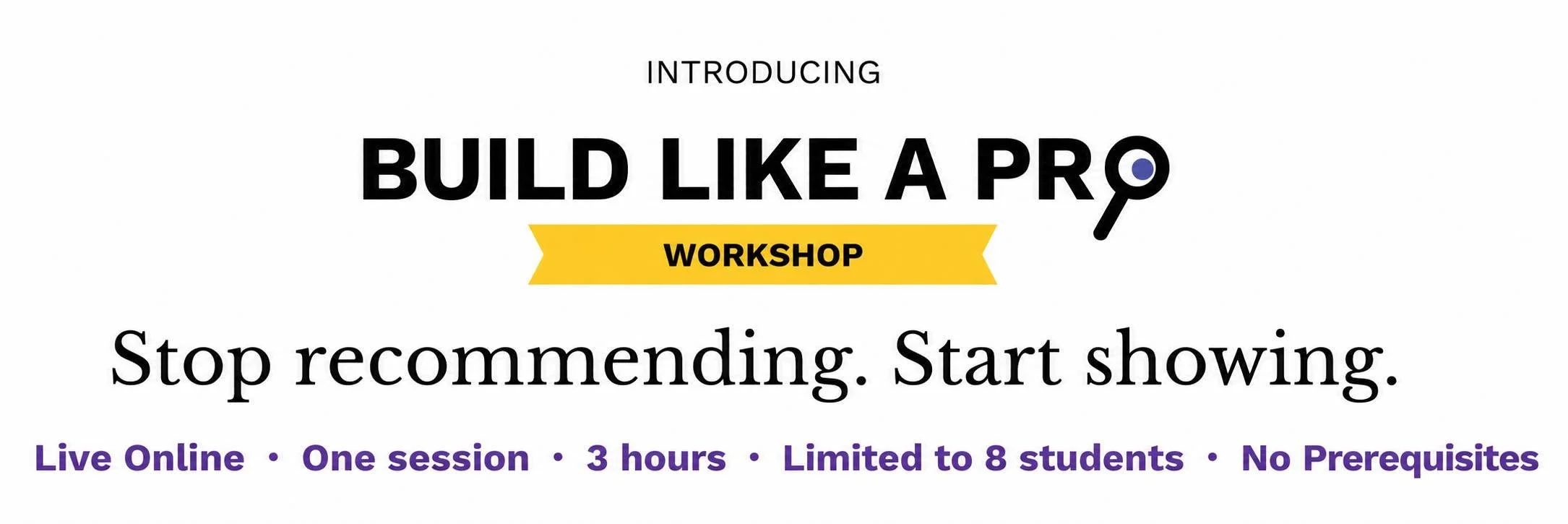
This is what BUILD Like A Pro teaches.
Not how to be a designer. Not how to make beautiful artifacts. How to fold the bear.
The small build. The scrappy prototype. The clickable mockup. The video walkthrough. The working MVP. The thing the stakeholder sees and reacts to before they read the brief.
You did the research. You earned the insight. You delivered the recommendation.
Are you going to show them a swan, a toad, or more words?
Build Like A Pro
BUILD Like A Pro is one live 3-hour session. Pick the date that works for you.
Saturday July 11 · 9am–12pm PT / 12-3pm ET
Tuesday, July 21 · 3–6pm PT / 6-9pm ET
$197 per seat. Eight seats per session. One seat per session is reserved for currently unemployed researchers at 50% off. Email michele@curiositytank.com.
You will leave with a working build or prototype, case study ready, prompt templates included.
Pick your date and register here.
Here's to all the people who fold towel animals. They will never know I wrote about them. They are still in some room, folding the next one, training the next person, repeating the craft.
Be the person folding the bear. Be that researcher.
Stay curious,
Michele
Speak up, get involved, and share the love!
Connect with Michele on LinkedIn for more UXR tips and UX discussions.
Read about Curiosity Tank workshops.
Interested in team user research training? Let us know!
Participate as an On-Demand for less!
Dive into a different UX Research term every week! Sign up for UX Lex weekly emails here.
Forward this email to someone you think might enjoy it. Better yet, sign them up here. It will be the gift that keeps on giving.
And that’s a wrap!
We try to alternate between a theme and Insights/UX/UXR jobs, events, classes, articles, and other happenings every so often. Thank you for all of the feedback. Feedback is a gift, and we continue to receive very actionable input on how to make Fuel Your Curiosity more meaningful to you.
What do you think? We're constantly iterating and would love to hear your input.
Stay curious,
- Michele and the Curiosity Tank team
