Why Generative Research Isn’t Enough in Competitive Markets
Yesterday I posted about “Right-to-Win” research. A few people DM'd how it’s different from generative exploration.
Generative research asks:
What problems exist?
Where is the unmet need?
What opportunities are emerging?
It opens the space.
Right-to-Win research assumes the space is already crowded. Competitors exist. Parity is table stakes.
So the question becomes: Given the real alternatives in the market, where can we actually win?
I mentioned completing two R2W studies. One was in FinTech. We were not exploring workflows or validating demand. That domain is mature. Multiple players are credible and well-known.
The real questions were:
Where do we have a structural advantage?
Where is parity required just for consideration?
Where are the current leaders vulnerable?
Where should we not invest at all?
That framing is very different from exploration.
We were not testing features. We were mapping enterprise decision criteria against competitive realities:
What drives switching?
What creates lock-in?
What signals credibility at scale?
Those insights shaped the expansion and investment strategy. Not what customers say they like, but what SHIFTS OUTCOMES RELATIVE TO ALTERNATIVES.
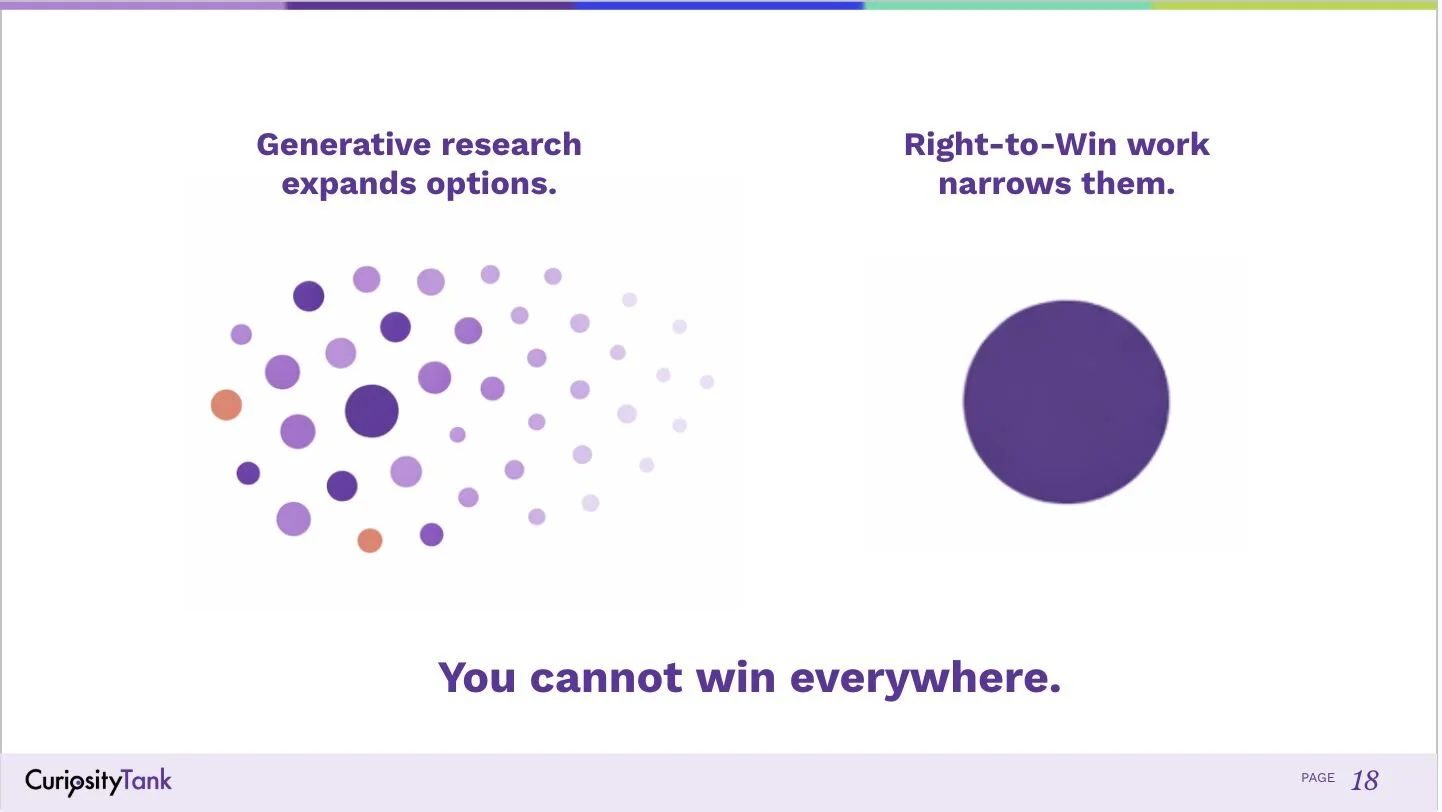
Generative work expands options. Right-to-Win work narrows them. You cannot win everywhere. You do not need to compete on every dimension. You have to choose.
That clarity can be uncomfortable. It is also powerful.
R2W studies force explicit tradeoffs. That’s what separates participation from ADVANTAGE.
