
Right-to-Win Studies: A Strategic Frame for UX Research
I recently completed two “right-to-win” research studies. I’d never heard the term before. Have you? I’m kind of obsessed with it now.
It’s not a new method. It’s not a toolkit. And it’s not about validating ideas or exploring broad opportunity spaces.
It’s a framing device.
A way of clarifying:
Where an organization can truly lead
Where it needs to achieve parity
And where it probably shouldn’t compete at all
…all relative to the existing competitive set.
I didn’t invent this label. “Right-to-win” was the language both clients used. It was their shorthand for work that combines strategy and research to answer what it will take TO WIN, not just participate.
These were large, complex projects in completely different industries. I'm not sure if that’s a coincidence. Thoughts?
I’m seeing a shift in decision pressure, too.
Markets are crowded. Parity shows up fast. Once something works, it gets copied almost overnight. Differentiation windows are compressed.
Shipping features no longer equals differentiation.
Leaders are less interested in ideas and more interested in "advantage".
The questions I’m hearing are changing, too.
Less: “What should we build next?”
More: “What will it actually take to change outcomes?”
There’s more scrutiny now around where real money, time, and attention should go. As there should be.
I’m going to write more about these right-to-win studies because they were fascinating to run and incredibly actionable for the teams.
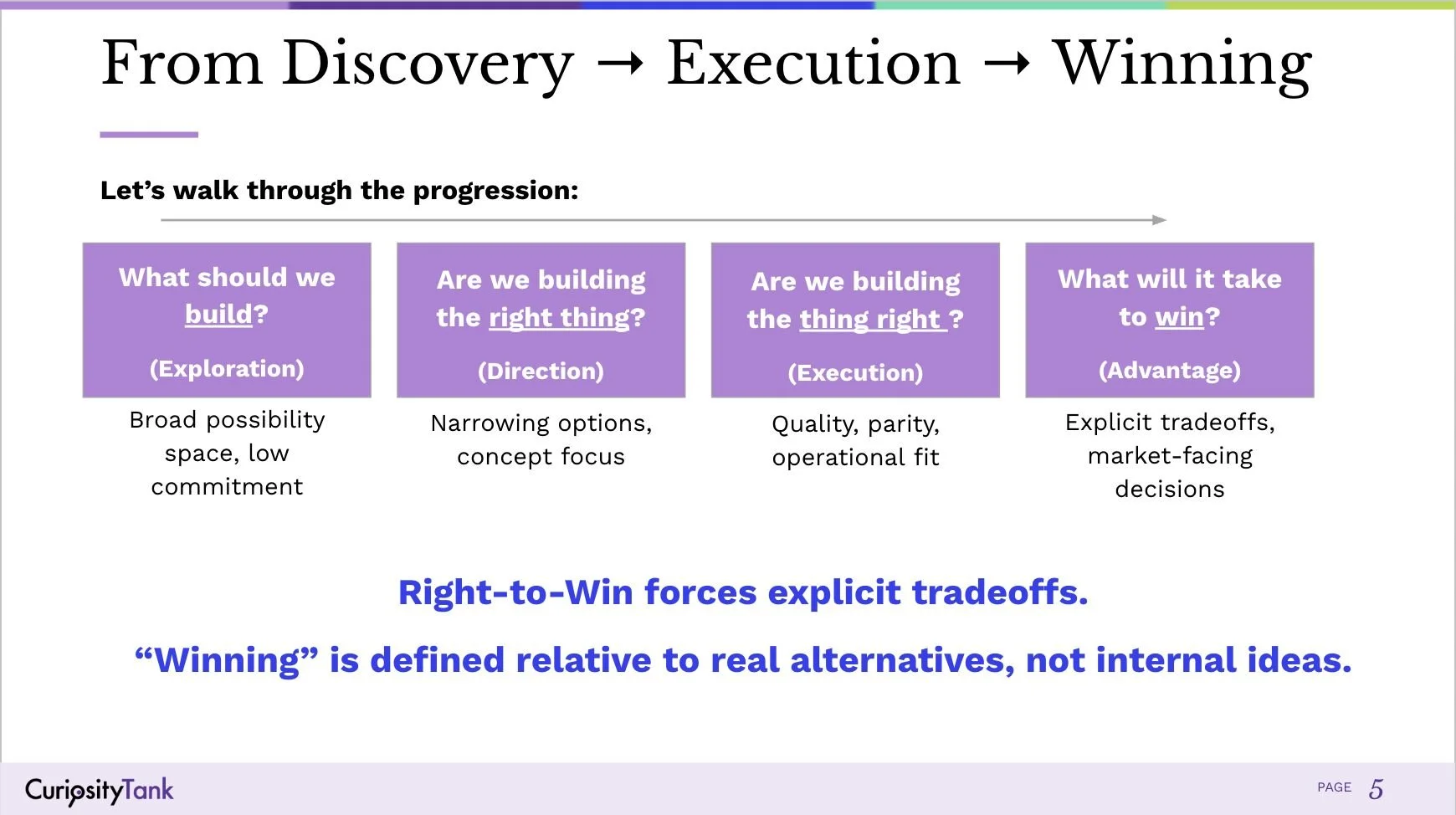
This slide is from a recent presentation I gave to a consultancy about the right-to-win studies. It frames the progression from discovery → execution → winning.
More soon.
Would love to hear your thoughts and questions in the meantime. Think this is a new trend?
